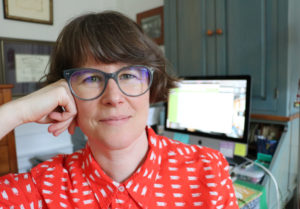
 Alexis Clements is a writer and filmmaker based in Brooklyn, New York (traditional land of the Lenape people). Her creative work has been produced, published, and screened across the US, and in Europe, South America, and Asia. Her feature-length documentary film, All We’ve Got, premiered at NewFest, has toured the globe, and is currently airing on select PBS stations around the US. In 2021 she launched a podcast called The Answer is No. She regularly publishes essays and reviews online, and is currently at work on two projects that mix prose and film.
She has been awarded a New York State Council on the Arts Grant, a New York City Artist Corps Grant, a Bruce and Arch Brown Foundation Grant, a Dramatists Guild of America Fellowship, two Puffin Foundation Artist Grants, a Ludwig Vogelstein Foundation Grant, and the Source Theatre’s Washington Theatre Festival Literary Prize. She has been a resident at the Millay Colony, as well as the Helene Wurlitzer Foundation, and is an alumna of the WP Theater Playwrights Lab. She is also founder of the multi-disciplinary arts project New Acquisition, which produced projects from 2007-2010, and a co-founder of the queer writing group and publisher, Private Commission, which was active from 2012-2017.
Her articles, essays, and interviews have appeared in publications such as The Los Angeles Review of Books, BOMB, Salon, Hyperallergic, Bitch Magazine, American Theatre, The Brooklyn Rail, Two Serious Ladies, Autostraddle, The L Magazine, and Nature, among others.
Productions of her plays and performances include (but are not limited to): Unknown (20% Theater Company, Minneapolis, MN); The Elephant in the Room (LaBute New Theater Festival, St. Louis, MO); Conversation (Fringe Festival: Philadelphia, PA); Enough! (Highline Park: New York, NY); Place ReImagined (Women’s Project & River-to-River Festival: New York, NY); Dance Away Your Debt (FIGMENT Festival: Governors Island, NY & Dance Parade: New York, NY); Spitting Against the Wind (Brooklyn Arts Exchange: Brooklyn, NY & Dixon Place: New York, NY); Your Own Personal Apocalypse (One Million Forgotten Moments Project: New York, NY & Chashama: New York, NY); Causality (Towngate Theater: Wheeling, WV); The Interview (Edinburgh Fringe Festival: Scotland, UK); Three Choices (Pomegranate Theatre: Chesterfield, UK); and Pieces (Riverside Theatre: Iowa City, IA).
She served as a co-editor of Women in Theatre Magazine Online (2012-2013) and she co-edited the two-volume anthology of plays, Out of Time & Place (published in 2010), which includes her performance piece, Conversation. She was the invited to guest edit the 40th anniversary volume of Sinister Wisdom titled Variations. Her plays, Pieces and Three Choices, have been published by KNOCK. She has also written and published a selection of short stories which have appeared in literary magazines and collections, including The Guardian and two different anthologies published by Route (UK), Bonne Route and Ideas Above Our Station.
Alexis has led numerous workshops and moderated panels focused on labor issues within the arts, writing, and LGBTQ communities. These discussions, workshops, and panels have taken place at venues ranging from the Brooklyn Museum to the New York Historical Society to the School of Visual Arts. In addition, she has been an invited speaker at Harvard University, Emerson College, TEDx Chelsea, the Flux Factory, and the Playwrights Forum, among others.
Alexis currently serves on the Coordinating Committee at the Lesbian Herstory Archives. In 2017, she co-founded the monthly program, Little Rainbows: Story Time at the Lesbian Herstory Archives (no longer active). She has also volunteered with a handful of other organizations including the Willie Mae Rock Camp for Girls and University Settlement’s Older Adults Program, as well as serving terms on the boards of CLAGS: Center for LGBTQ Studies and TJ Alumni for Racial Justice.
Alexis has a M.Sc. in Philosophy & History of Science from the London School of Economics and Political Science and a B.A. in Theater Studies from Emerson College.